


Ready to drive organic growth? Explore 5 simple strategies for sustainable expansion, lasting brand trust, and long-term value.
Drive organic growth by leveraging your existing resources and internal capabilities to expand your business sustainably. Unlike inorganic growth through mergers and acquisitions, organic growth builds authentic connections with your audience and creates lasting value.
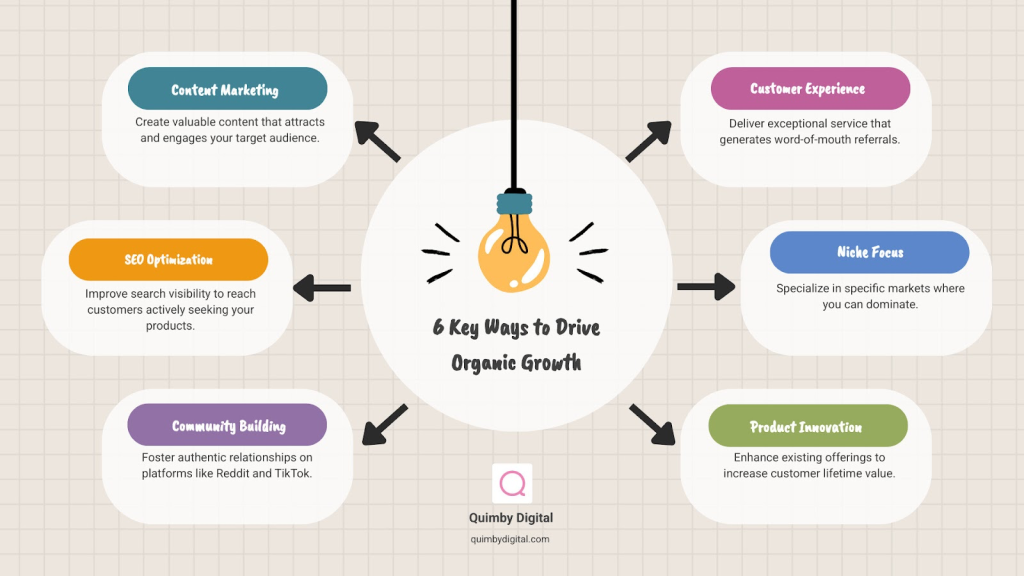
Key ways to drive organic growth:
- Content Marketing – Create valuable content that attracts and engages your target audience
- SEO Optimization – Improve search visibility to reach customers actively seeking your products
- Community Building – Foster authentic relationships on platforms like Reddit and TikTok
- Customer Experience – Deliver exceptional service that generates word-of-mouth referrals
- Niche Focus – Specialize in specific markets where you can dominate
- Product Innovation – Improve existing offerings to increase customer lifetime value
The numbers tell the story: companies focused on organic growth generate higher shareholder returns than those relying heavily on acquisitions. In 2023, the average firm achieved 10.2% organic growth, while top performers reached 18.7%.
Organic growth means expanding your business from within using your team’s skills, brand reputation, and customer relationships. It’s the opposite of inorganic growth, which relies on external investments like buying other companies or expensive advertising campaigns.
Think of it like nurturing a garden versus buying pre-grown plants. Organic growth takes patience, but it creates deeper roots and more resilient success. Your brand builds genuine trust, authentic community, and sustainable competitive advantages that are hard for competitors to replicate.
For wellness, CPG, and tech brands especially, organic growth offers a path to meaningful connections in an increasingly noisy digital landscape. Rather than interrupting potential customers with ads, you attract them naturally by solving their problems and adding real value to their lives.
Why Prioritize Organic Growth? (The Sustainable Advantage)
Picture this: you’re scrolling through your feed and see an ad for a wellness product. Now imagine finding that same product through a friend’s genuine recommendation or a helpful blog post. Which one feels more trustworthy? That’s the magic of organic growth.
While flashy mergers and acquisitions grab headlines, organic growth quietly builds the foundation for lasting success. Recent data shows M&A deals dropped over 21% year-on-year as smart companies pivot toward sustainable expansion strategies. Why? Because organic growth creates something money can’t buy: authentic relationships with your customers.
Benefits of Organic Growth
When you choose to drive organic growth, you’re investing in your brand’s future. The long-term ROI is remarkable. Unlike paid ads that disappear the moment your budget runs out, organic efforts keep working for you. That blog post you wrote six months ago? It’s still attracting customers today.
Trust and authenticity naturally develop when customers find you organically. Think about it – when someone finds your brand through a Google search or a friend’s recommendation, they’re already more receptive. This isn’t just feel-good marketing speak. 73% of consumers will switch to a competitor after multiple bad experiences, making trust your most valuable asset.
The community building aspect sets organic growth apart. Instead of interrupting people with ads, you’re creating genuine connections. Your customers become advocates who share your content, recommend your products, and defend your brand online. This word-of-mouth marketing is priceless.
From a technical standpoint, consistent organic efforts build your SEO authority. Search engines recognize you as a credible source, pushing you higher in results and attracting more qualified traffic. It’s like compound interest for your online presence.
The cost-effectiveness becomes clear over time. While you’ll invest upfront in content creation and community building, the cost-per-lead can drop dramatically. Many brands see their content marketing costs decrease by 80% within five months as their organic engine gains momentum.
Most importantly, companies focused on organic strategies consistently show higher shareholder returns. You’re not just growing revenue – you’re building a fundamentally stronger, more resilient business.
Drawbacks of Organic Growth
Let’s be honest about the challenges. Organic growth requires patience. If you’re expecting overnight success, you’ll be disappointed. SEO results typically take 6-12 months to materialize. Building a loyal community takes even longer.
Slower results can feel frustrating, especially when you see competitors getting quick wins with paid campaigns. If you need immediate traffic for a product launch, organic alone might not deliver the speed you need.
Algorithm dependency is another reality. While we create content for humans, platforms like Google and social media sites control visibility. Algorithm changes can impact your reach overnight, requiring constant adaptation and flexibility.
The data from organic efforts isn’t always as precise as paid campaigns. You might not get the granular, real-time feedback that comes with paid advertising, making it harder to optimize quickly.
Despite these challenges, the benefits far outweigh the drawbacks for brands seeking sustainable success. You’re building a house, not renting a billboard.
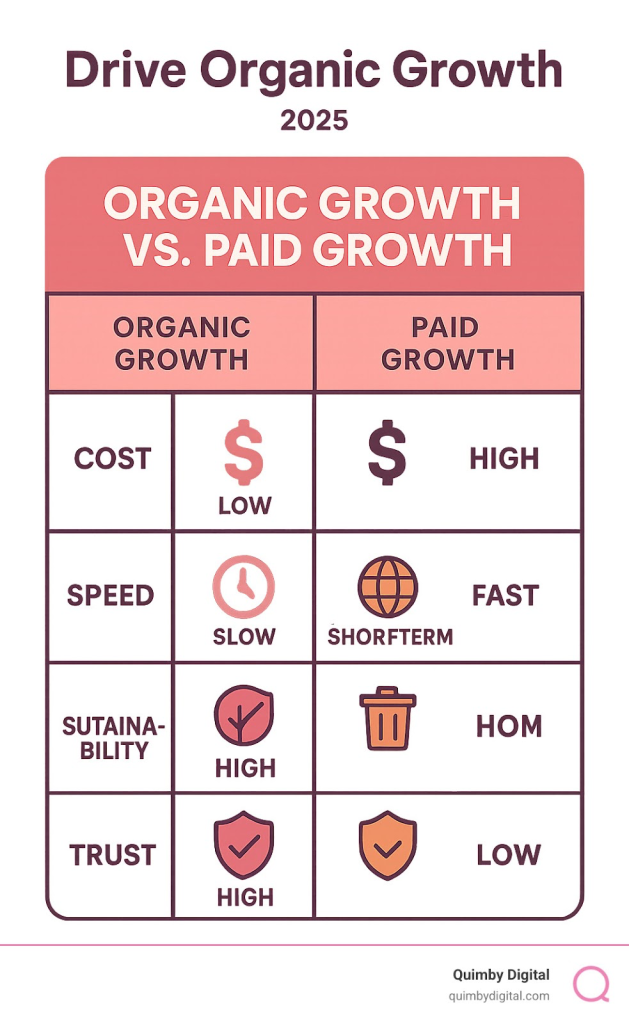
This comparison makes the choice clear. While paid growth offers speed, organic growth delivers sustainability, trust, and long-term value. For wellness, CPG, and tech brands especially, this authentic approach resonates with audiences who crave genuine connections in an increasingly noisy digital world.
5 Foundational Strategies to Drive Organic Growth
Now that we understand the “why,” let’s dive into the “how.” To drive organic growth effectively, you need a strategic approach that builds on what you already have. It’s not about starting from scratch—it’s about maximizing your internal resources, understanding your customers deeply, and creating authentic connections that last.
Think of these five strategies as the foundation of your growth house. Each one supports the others, and together they create something much stronger than any single tactic could achieve alone.

Strategy 1: Master Your Market with Deep Research & Niche Focus
Here’s the truth: you can’t grow organically if you don’t know who you’re growing for. The most successful brands we work with have one thing in common—they know their audience better than anyone else does.
Target audience research isn’t just a nice-to-have; it’s your growth foundation. Companies that regularly research their audience grow 70% faster and are nearly 50% more profitable than those that don’t. But we’re not talking about surface-level demographics here. You need to understand what keeps your customers up at night, what makes them excited, and exactly how they talk about their problems.
This research transforms into detailed buyer personas—those semi-fictional characters that represent your ideal customers. These personas guide everything from your content calendar to your product development decisions. When you know that Sarah, your wellness brand’s target customer, scrolls TikTok at 9 PM looking for stress relief tips, you can create content that meets her exactly where she is.
But here’s where most brands go wrong: they try to appeal to everyone. Niche specialization might feel limiting, but it’s actually liberating. High-growth firms are 75% more likely to have a highly-focused niche. When you dominate a specific segment, you become the obvious choice for that audience.
Your competitive advantage emerges from this focus. Instead of competing on price or features alone, you compete on deep understanding and specialized expertise. You become the brand that “gets it” in a way that generalist competitors simply can’t match.
More info about social media marketing & SEO hacks
Strategy 2: Build an Unforgettable Brand & Customer Experience
Your brand isn’t your logo or your color palette—it’s every single interaction someone has with your business. And in organic growth, those interactions need to be so good that people can’t help but tell their friends about you.
Strong brand identity starts with consistency. Your voice, visual elements, and messaging should feel cohesive whether someone finds you on TikTok, your website, or through a friend’s recommendation. This consistency builds the familiarity that makes people choose you over competitors they’ve never heard of.
But consistency means nothing without a customer-centric culture. Every decision, from your return policy to your social media responses, should prioritize the customer experience. When your entire team understands that customer satisfaction drives organic growth, magic happens.
Exceptional service isn’t optional—it’s your growth engine. 73% of consumers will switch to a competitor after multiple bad experiences. But flip that around: exceptional service creates the kind of customer loyalty that money can’t buy. These delighted customers become your unpaid marketing team through word-of-mouth marketing.
Customer retention deserves special attention here. It costs five times more to acquire a new customer than to keep an existing one. Focus on increasing customer lifetime value through personalized experiences and thoughtful loyalty programs. The sweet spot? Getting customers to make a second purchase within 90 days—they’re worth more than double the average customer’s lifetime value.
How to Use Social Media to Build Trust With Your Audience
Strategy 3: Create a Content Engine to Drive Organic Growth
Content is where organic growth gets exciting. It’s your 24/7 salesperson, your brand ambassador, and your community builder all rolled into one. But here’s the catch: only 40% of marketers have a documented content marketing strategy. That’s a massive opportunity for those who get it right.

Your content marketing strategy should be like a roadmap that connects your audience’s needs with your business goals. It’s not about creating content for content’s sake—it’s about solving problems, answering questions, and providing value at every stage of the customer journey.
SEO fundamentals are non-negotiable here. SEO acts as the hub that connects all your other growth strategies. When your content ranks on the first page of Google (which gets a 28.5% click-through rate compared to 2.5% for page two), you’re capturing people actively looking for solutions you provide.
Blogging remains one of the most powerful organic tools available. Companies that blog see 126% higher lead growth and end up with 434% more indexed pages than those that don’t. But don’t sleep on video marketing—YouTube is the second-largest search engine, and 69% of B2B marketers are investing more in video content.
The pillar and cluster model organizes your content in a way that both humans and search engines love. Create comprehensive pillar pages around your main topics, then support them with cluster content that dives deep into specific subtopics. This approach establishes your authority while making it easy for visitors to find exactly what they need.
Don’t forget about optimizing beyond Google. YouTube SEO, TikTok findability, and even AI chatbot optimization are becoming crucial for reaching audiences where they actually spend their time.
What is a Digital Creator? How to Become One
Strategy 4: Foster Thriving Communities to Drive Organic Growth
In a world of endless digital noise, authentic community has become incredibly valuable. When you build a real community around your brand, you create something competitors can’t easily replicate or buy their way into.
Community building goes beyond having a Facebook group or Discord server. It’s about creating spaces where your audience feels genuinely connected to each other and to your brand. The number of companies with dedicated community departments grew from 15% to 22% in 2022, with acquisition being a top goal.
Social media engagement is where community building comes to life. Instead of broadcasting messages into the void, you’re having real conversations. You’re responding to comments, asking questions, and making your brand feel human. This two-way communication builds relationships that translate directly into loyalty and sales.
User-generated content is community gold. When customers create content featuring your products or sharing their experiences, it’s more authentic and persuasive than anything you could create yourself. Plus, sharing UGC celebrates your customers while providing you with fresh, relatable content.
For wellness, CPG, and tech brands, Reddit marketing and TikTok strategy offer unique community opportunities. Reddit’s niche communities let you engage with passionate audiences around specific topics. TikTok’s culture rewards authenticity and creativity, making it perfect for showing your brand’s personality and building genuine connections.
When done right, community building creates brand advocacy. These advocates don’t just buy from you—they defend you, recommend you, and provide invaluable feedback that helps you improve. It’s organic growth that literally grows itself.
We Grew a Client by 20k Followers in Two Months (and How You Can Do the Same)
Strategy 5: Leverage Product, Partnerships, and Data
The final strategy brings together three powerful elements that can accelerate everything else you’re doing. When your product, partnerships, and data work together, you create a growth system that’s both sustainable and scalable.
Product-led growth happens when your product itself encourages growth. Think about growth loops—where satisfied users naturally bring in new users. Maybe your app has social features that work better with friends, or your service includes sharing tools that spread awareness. The key is building growth mechanisms directly into what you’re selling.
Strategic partnerships let you tap into established communities without starting from scratch. Partner with complementary brands for co-marketing campaigns, joint webinars, or content exchanges. These partnerships expose you to new, relevant audiences who are already primed to trust you based on the partnership itself.
Referral programs formalize the word-of-mouth marketing that’s already happening. When you make it easy and rewarding for happy customers to bring friends, you’re turning satisfaction into a systematic growth driver.
Data analytics keeps everything on track. While organic growth isn’t as immediately measurable as paid advertising, you still need to track what’s working. Monitor website traffic, keyword rankings, engagement rates, and conversion rates to understand your progress and identify opportunities.
A/B testing helps you optimize everything from email subject lines to website layouts. Even small improvements compound over time, and testing ensures you’re always learning and improving rather than guessing.
5 Metrics to Record for Social Growth
Cultivating a Culture of Growth: Leadership and Adaptability
Here’s the truth: drive organic growth isn’t something you can delegate to your marketing team and forget about. It requires a complete shift in how your entire organization thinks and operates.

We’ve seen too many CEOs throw their hands up and accept declining organic growth as “just how things are.” Others push all the responsibility down to their operating units and wonder why nothing changes. Both approaches are missing the point entirely.
Leadership must own organic growth from the top down. This means CEOs and senior leaders actively championing growth initiatives, setting clear expectations, and holding teams accountable for results. When leadership treats organic growth as a priority, everyone else follows suit. It’s about creating an environment where growth isn’t just the marketing department’s problem—it’s everyone’s opportunity.
The magic happens when you foster cross-functional collaboration. Your product team’s insights can inform your content strategy. Your customer service team’s feedback can spark new community initiatives. Your sales team’s conversations can reveal untapped market opportunities. When leaders focus on breaking down silos and encouraging cross-functional priorities, time-to-market improves by 20 to 30 percent on average.
Embracing an agile mindset is non-negotiable in today’s fast-moving digital landscape. The platforms, algorithms, and customer behaviors that worked last year might be completely different today. Your team needs to be comfortable with rapid iteration, testing new approaches, and learning from both successes and failures.
This agility extends to adapting to market changes and competition. Regular market research isn’t a nice-to-have—it’s essential for spotting new opportunities and staying ahead of shifts in your industry. Maybe there’s an emerging platform where your audience is gathering. Perhaps customer needs have evolved in ways that create new content opportunities. The brands that drive organic growth successfully are the ones constantly scanning the horizon.
Data-driven decision making should be woven into your organization’s DNA. Every strategy, every campaign, every piece of content should be informed by insights from your analytics. Companies with strong data capabilities are significantly more likely to be top-growth performers. This isn’t about drowning in spreadsheets—it’s about making smarter decisions based on what your audience actually responds to.
Finally, employee empowerment transforms your entire team into growth drivers. When people feel equipped with the right training, tools, and autonomy to identify and pursue opportunities, amazing things happen. Your customer service rep might spot a trending topic perfect for content. Your product manager might notice a feature that could drive referrals.
Building this enterprise-wide organic growth capability means everyone becomes invested in the company’s sustainable expansion, not just the people with “growth” in their job titles.
Frequently Asked Questions about Organic Growth
We get it – diving into organic growth can feel overwhelming, especially when you’re eager to see results. Let’s tackle the most common questions we hear from brands just like yours, based on our real-world experience helping wellness, CPG, and tech companies build sustainable growth.
How long does it take to see results from organic growth?
Here’s the honest truth: drive organic growth is a marathon, not a sprint. While we’d love to promise overnight success, organic efforts like SEO, content marketing, and community building typically take 6-12 months to show meaningful results.
Think of it like nurturing a garden. You plant seeds, water them consistently, and trust the process. At first, nothing seems to happen. Then suddenly, you’ve got a thriving ecosystem that feeds itself. The compounding effect of organic growth means your efforts today continue working for months and years ahead, building lasting authority and genuine connections.
SEO results often start appearing around the 3-month mark, but significant traffic growth usually kicks in between months 6-12. Content marketing follows a similar timeline – your early blog posts might feel like they’re shouting into the void, but they’re actually building the foundation for future success.
The beauty of this patience? Once your organic engine gets rolling, it becomes incredibly cost-effective and self-sustaining. Unlike paid ads that stop working the moment your budget runs out, organic growth keeps delivering long after you’ve hit publish.
Can organic and paid growth work together?
Absolutely! This is one of our favorite questions because the answer is so empowering. While we’re passionate advocates for organic growth, we believe in smart hybrid strategies that leverage the best of both worlds.
Paid amplification can boost your organic content. When you create a blog post or video that’s performing well organically, a small ad budget can help it reach even more of your ideal audience. It’s like adding rocket fuel to something that’s already working.
Testing with paid ads gives you quick feedback on what resonates with your audience. You can test headlines, messaging, and offers with paid campaigns, then use those insights to refine your organic content strategy. Retargeting organic visitors is another powerful combination – someone finded you through organic search, then you re-engage them with targeted ads featuring your best offers.
The magic happens when both strategies work together seamlessly. Your organic efforts build trust and authority, while paid campaigns accelerate reach and provide valuable data to improve your organic approach.
Organic & Paid Social Media Campaigns
What’s the first step I should take to drive organic growth?
If all these strategies feel overwhelming, take a deep breath. The very first step is beautifully simple: understand your audience and define your niche.
Before you write your first blog post or create your first TikTok, you need crystal clarity on who you’re serving. Audience research isn’t just a nice-to-have – it’s the foundation everything else builds on. You need to know their biggest pain points, where they spend time online, and what language they use to describe their problems.
Understanding customer needs means going beyond demographics to uncover the emotional drivers behind their decisions. What keeps them up at night? What would make their lives easier? How does your product or service uniquely solve their problems?
Defining your niche is equally crucial. Rather than trying to appeal to everyone, focus on becoming the go-to solution for a specific group of people. This specialization allows you to speak directly to their needs and build genuine authority in your space.
Once you have this foundation, setting clear goals becomes much easier. You’ll know exactly what success looks like and can create a roadmap that actually leads somewhere meaningful. Every piece of content, every social media post, and every community interaction will have purpose and direction.
Start here, and everything else will fall into place naturally.
Conclusion
Think of drive organic growth as tending a garden rather than buying flowers from the store. It takes patience, care, and consistent nurturing, but what you create is far more beautiful and lasting than anything you could purchase.
Throughout this journey together, we’ve explored why organic growth isn’t just another marketing strategy—it’s the foundation of truly resilient businesses. While inorganic growth through acquisitions might grab headlines, the companies that stand the test of time are those that build authentic relationships with their customers, one interaction at a time.
The five foundational strategies we’ve covered aren’t just theoretical concepts. They’re proven approaches that transform businesses from the inside out. Deep market research helps you speak directly to your customers’ hearts. Unforgettable brand experiences turn casual buyers into lifelong advocates. Content engines attract the right people at exactly the right moment. Thriving communities create spaces where your customers become your biggest champions. And strategic partnerships and data amplify everything you’re already doing well.
But here’s what we’ve learned after years of working with wellness, CPG, and tech-forward brands: organic growth isn’t just about tactics and strategies. It’s about building something meaningful. It’s about creating genuine value in people’s lives and fostering connections that go beyond transactions.
Yes, organic growth requires patience. You won’t see overnight changes or viral explosions that disappear as quickly as they came. What you will see is steady, sustainable progress that compounds over time. You’ll build the kind of brand that people trust, recommend to their friends, and stick with through thick and thin.
At Quimby Digital, we’ve seen how powerful this approach can be. We don’t just implement cookie-cutter strategies—we innovate and adapt, especially on platforms like Reddit and TikTok where authentic community building thrives. We understand that every brand is unique, and we’re passionate about helping you find your own path to sustainable growth.
Ready to plant the seeds for your brand’s organic growth journey? We’d love to help you cultivate something extraordinary.
Grow smarter, not harder. Boost online visibility, enhance audience engagement, and evolve with tech-driven marketing.