


Tech brand strategy is the roadmap that turns your technology into a trusted, memorable brand. In today’s crowded digital landscape, great technology isn’t enough—you need a strategic approach to how you position, communicate, and deliver value.
A winning tech brand strategy includes:
- Brand Foundation: A clear purpose, mission, and values.
- Market Positioning: A unique value proposition that sets you apart.
- Brand Identity: Consistent visuals and messaging across all touchpoints.
- Audience Connection: Deep understanding of customer needs.
- Content Strategy: Thought leadership that builds trust.
- Community Building: Engagement that turns customers into advocates.
The stakes are high. Your brand has just seven seconds to make a first impression, which often determines whether a prospect becomes a customer. With over 80% of consumers needing to trust a brand before buying, and 77% preferring brands that share their values, your strategy directly impacts your bottom line.
Tech branding faces unique challenges: balancing simplicity with technical depth, building trust in a skeptical industry, and staying relevant as technology evolves. The companies that succeed don’t just build great products—they build great brands that create emotional connections and foster loyalty.
This guide will show you how to craft a strategy that cuts through the noise and drives real business results.
The Core Components of a Winning Tech Brand Strategy
Building a successful tech brand strategy requires creating something authentic that speaks to your audience’s needs. It starts with three essential components that work together to create a brand people care about.
Define Your Purpose, Mission, and Values
Your brand’s purpose is the “why” behind what you do—the positive change you want to create. For example, Apple’s vision isn’t just making products; it’s “to make the best products on earth and leave the world better than we found it.” This purpose transcends features.
Your mission statement explains what you do and for whom, while your core values guide every decision. This matters because 77% of customers prefer brands with shared values. When your values around social responsibility, privacy, or accessibility are clear, you connect with customers who share them.
Your brand promise is your commitment to the customer experience. When your internal culture matches your external messaging, you achieve authenticity.
Understand Your Target Audience and Market Position
Next, get clear on who you’re serving and where you fit in the market. Market research helps you understand what customers actually need. Nearly 60% of consumers want better understanding from brands, so dig into their challenges and goals.
Create target personas—detailed profiles of your ideal customers. Understanding their motivations and frustrations helps you speak their language. Competitor analysis helps you find your unique space. If competitors use technical jargon, your Unique Value Proposition (UVP) could be simplicity. If they focus on enterprise clients, you might serve smaller businesses better.
The goal is to identify what makes you different and valuable. This might mean focusing on a specific niche where you can become the go-to expert.
Develop Your Brand Voice and Naming
Your brand voice is your personality in communication. Are you a helpful friend, an innovative leader, or a reliable partner? Brand archetypes like Apple (Creator/Magician) or IBM (Ruler/Expert) can provide a consistent framework.
Your tone of voice may shift with the context—a support email is more formal than a TikTok video—but your core personality should remain consistent. When it comes to naming, focus on what your audience will remember. Avoid technical jargon that confuses customers.
Key principles for naming a tech product:
- Simple and memorable: Easy to say, spell, and recall.
- Unique: Stands out and the domain is available.
- Connects to your purpose: Hints at what you do or the feeling you evoke.
- Long-term: Won’t limit you as you grow.
- Resonates with your audience.
- Tells a story: Works globally and connects with people.
A strong messaging framework brings your purpose, audience understanding, and brand voice together into relatable communications, building the trust that turns prospects into loyal customers.
Building an Authentic and Memorable Brand Identity
Here, we explore how to translate your strategy into tangible assets that create a consistent and compelling brand experience.
The Power of Storytelling and Authenticity
Your brand story is the emotional bridge connecting your technology to human experiences. Instead of focusing on features, explain why your solution exists and how it improves lives. The best tech brand strategy starts with a relatable story. Authentic origins—like building an app out of frustration or starting in a garage—create an emotional response that a feature list cannot.
Storytelling causes an emotional response by showing real value in action, like how your product saved a business owner time or made data accessible. But authenticity can’t be faked. With 88% of buyers valuing authenticity, your brand story must align with your company culture and customer experience. If you claim to be user-friendly, your interface must be intuitive. The story you tell externally must match your internal reality.
Social media is a great place to showcase this authenticity through real conversations and user-generated content. For more on this, see our guide on How to Use Social Media to Build Trust With Your Audience.
Crafting Your Visual Identity and User Experience
Your visual identity makes your brand story tangible. In tech, where first impressions are made in seconds, every visual choice matters. Great tech branding goes beyond a logo to create a complete sensory experience.
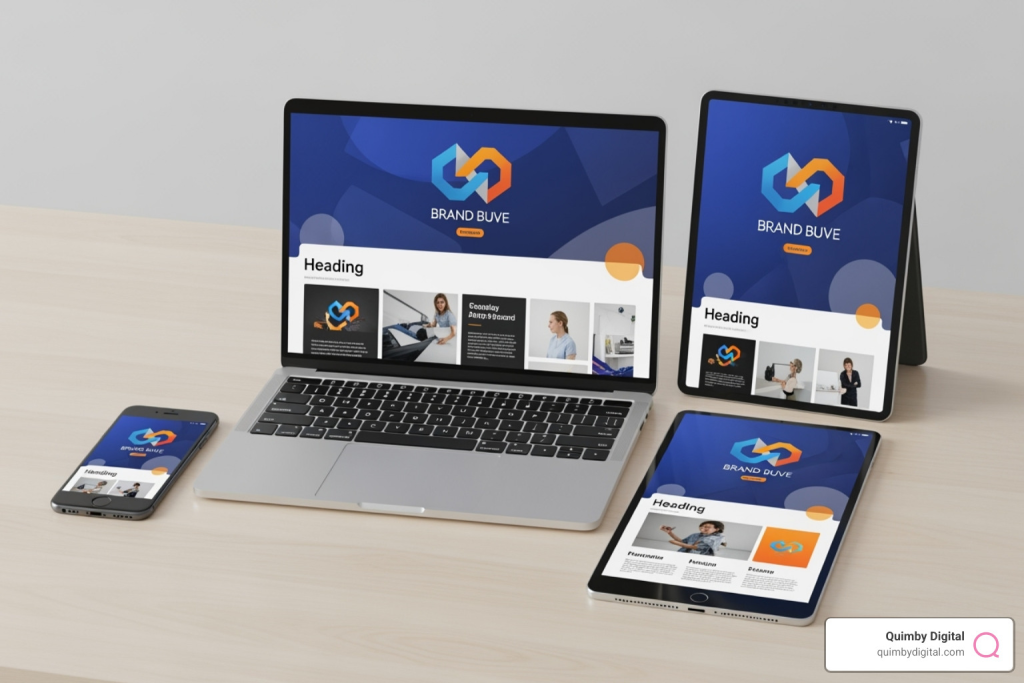
Your logo design is your signature. Thoughtful color psychology influences how people feel—calming blues can signal trust, while bold oranges convey innovation. Typography also speaks volumes about your personality; clean, modern fonts suggest forward-thinking, while traditional ones can convey stability. Your imagery should reflect your values and connect with your audience.
However, many tech brands miss a key point: an intuitive user experience (UX) is non-negotiable. Your website or app must make complex technology feel simple. The best visual identities blend form and function, being beautiful enough to attract attention and functional enough to guide users effortlessly. This integration of aesthetics and usability is what makes a tech brand great.
Ensuring Consistency Across All Platforms
Consistency builds recognition and trust. When your audience encounters your brand anywhere, they should immediately know it’s you. This starts with comprehensive brand guidelines that define not just visuals but also your messaging framework and tone of voice. These guidelines are the north star for all your content.
An effective omnichannel experience means adapting your core message to each platform while maintaining your brand’s essence. Your unified messaging might be more professional on LinkedIn and more conversational on TikTok, but the underlying personality remains constant. You adapt your communication style without changing who you are.
Employee advocacy is also key to consistency. When your team believes in your brand story, they become authentic ambassadors. This internal branding creates ripple effects beyond your marketing. Managing consistency requires strategic adaptation, not rigid uniformity, as we explore in So Many Platforms, So Little Time. Brands that nail consistency create a sense of familiarity and reliability that cuts through the noise.
Activating Your Brand: Engagement and Growth Strategies for 2025
Find modern strategies to bring your brand to life, build a loyal following, and drive measurable growth.
Content Marketing and SEO for Brand Authority
Content marketing is how your tech brand strategy comes alive. It establishes you as an expert worth listening to. The key is to lead with thought leadership that genuinely helps your audience. Instead of pitching, solve problems and answer questions. A cybersecurity firm might offer guides on data protection, while a SaaS platform could share workflow tips. This approach builds trust by proving your expertise.

Evergreen content—like tutorials and how-to guides—is a powerful asset that stays relevant and attracts visitors long after publication. Your SEO strategy ensures this content gets found by understanding what your audience searches for and creating content that answers their queries. Combining quality content with smart SEO builds a strong foundation. Don’t forget lead magnets like whitepapers or templates to capture interested prospects. For more on amplifying content, see our guide on Social Media Marketing SEO Hacks: Amplify Brand Presence.
Building Community and Leveraging Social Proof
Building a community is essential for long-term success. When customers connect and help each other, they become brand advocates. Community building starts with genuine engagement: listening and responding thoughtfully in online forums, social media groups, or during virtual events.
User-generated content is invaluable. When customers share tutorials or positive reviews, it carries more weight than any marketing message. Virtual events are a cost-effective way to bring your community together, showcase expertise, and strengthen loyalty.
Customer reviews and case studies provide the social proof that converts prospects. As 49% of SaaS marketers find case studies very effective, focus on gathering diverse stories with specific metrics and compelling quotes. Influencer marketing, especially with micro-influencers who genuinely use your product, adds another layer of authentic credibility.
Enhancing Your Image with Video Marketing
Video marketing helps tech brands stand out. Seeing a product in action or hearing a founder’s story is powerful.

Product demos show how your software works, building confidence. “Day in the life” videos are effective because they show your technology in context, focusing on outcomes over features. Founder stories add a human element, helping your audience connect with your mission.
Don’t overlook video SEO—optimizing titles, descriptions, and keywords helps your content get finded. The key is creating authentic videos that provide value and improve your brand story. For more detailed strategies, explore our insights on 5 Ways for Brands to Create Effective Video Content.
Future-Proofing Your Tech Brand
This final section looks at the long-term benefits, emerging challenges, and the role of digital change in maintaining a competitive edge.
The Long-Term Benefits of a Strong Brand
A strong tech brand strategy yields long-term benefits, the most valuable being customer loyalty. When customers connect with your brand’s values, they become advocates, providing word-of-mouth recommendations.
This loyalty creates powerful competitive differentiation. While others compete on features, your brand becomes the reason customers choose you, allowing for premium pricing. A strong brand also drives increased market value, as investors evaluate brand strength and customer loyalty, leading to better valuations.
Your brand also becomes a magnet for talent acquisition, as top professionals want to work for companies they admire. This creates a positive cycle of attracting great people. A strong brand enables sustainable growth, providing stability during downturns and amplifying success during growth phases.
Navigating Challenges and Digital Change
The tech world moves fast. Market saturation and rapid innovation make it hard to stay relevant. Customer skepticism about technology, privacy, and security adds another layer of complexity, requiring transparency and consistency to build trust.
However, digital change also brings opportunities. AI and machine learning help personalize experiences at scale and predict customer needs. Data-driven insights allow for precise fine-tuning of everything from website copy to social media content.
The brands that thrive accept change, using new tools to strengthen their core brand promise while remaining flexible. It’s not about chasing every trend, but about using innovation to serve customers better.
A smart tech brand strategy in 2025 balances timeless principles like authenticity and customer focus with cutting-edge tools that make those principles more powerful than ever.
Frequently Asked Questions about Tech Branding
Let’s tackle the most common questions we hear from tech-forward brands looking to make their mark.
What are the key pillars of a tech brand strategy?
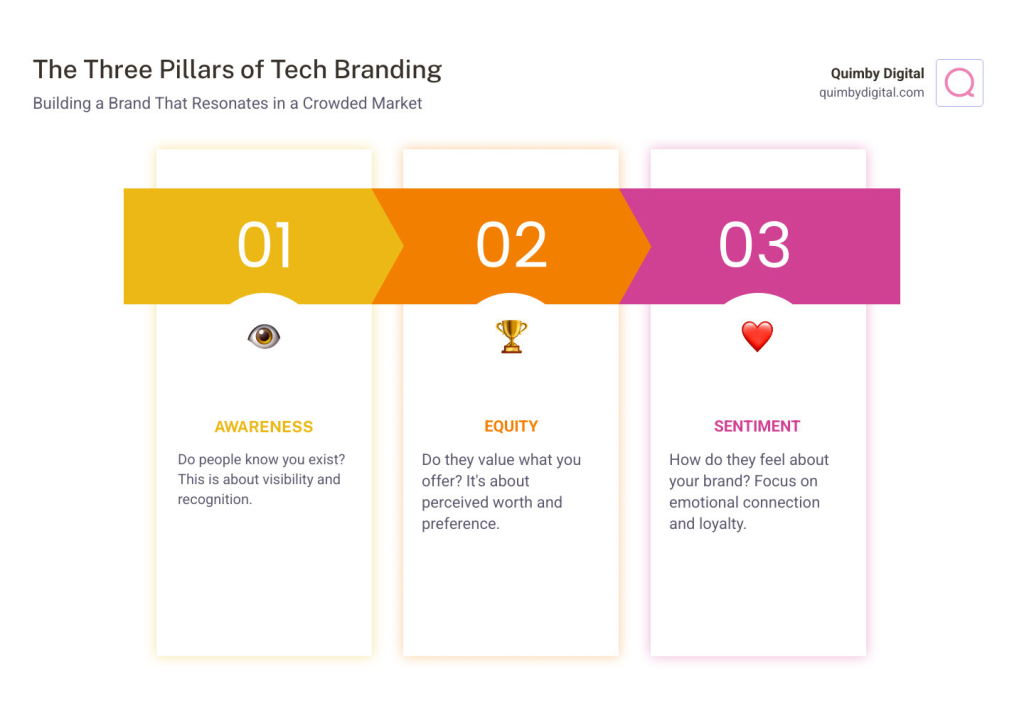
A tech brand strategy rests on three essential pillars: Awareness, Equity, and Sentiment.
- Awareness: Do the right people know you exist? Without visibility to your target audience, even the best product is invisible.
- Equity: Do people value what you offer? This is about being seen as a trusted authority that customers choose over competitors.
- Sentiment: How do people feel about your brand? This emotional connection is what turns a one-time customer into a lifelong advocate.
A winning strategy addresses all three pillars to build a brand that is recognized, valued, and loved.
How can a tech company differentiate itself in a crowded market?
True differentiation comes from understanding what makes you uniquely valuable to a specific audience, not just from features.
Start by carving out a unique market position. Perhaps you’re the most secure, the simplest to use, or the best at customer service. Your brand story is also a powerful differentiator; people connect with purpose and authenticity. Focus on a specific niche where you can become the go-to solution. It’s better to be the expert for a select group than just another option for everyone. Differentiation is about what you consistently deliver through your brand personality, customer experience, and core values.
Why is building a community so important for tech brands?
A thriving community transforms the often impersonal relationship with technology into something warm and human. Communities turn customers into advocates, and peer recommendations are incredibly powerful in the tech space.
Your community also provides an invaluable feedback loop for product development, offering direct insight into user needs and innovative use cases. It creates a built-in support network where users help each other, reducing the burden on your customer service team and deepening engagement.
Most importantly, communities generate authentic social proof that builds trust and credibility. When potential customers see real people excited about your brand, it becomes your strongest competitive advantage.
Conclusion
Building a successful tech brand strategy is an ongoing journey of defining your purpose, understanding your audience, and telling authentic stories. In a fast-moving landscape, your brand must be both consistent and agile, balancing technical complexity with human simplicity.
Authenticity is your competitive advantage. With most buyers valuing authenticity and shared values, being genuine is a powerful differentiator. The brands that thrive master storytelling, build communities, and leverage social proof to create emotional connections and amplify their impact.
The future belongs to tech brands that use digital change to improve their human touch. As AI evolves, the goal is to create more meaningful, personalized experiences that build trust.
For tech-forward brands ready to build authentic communities and drive organic growth, partnering with a specialized agency provides the expertise to lead the competition. Explore our services to see how we can help.