

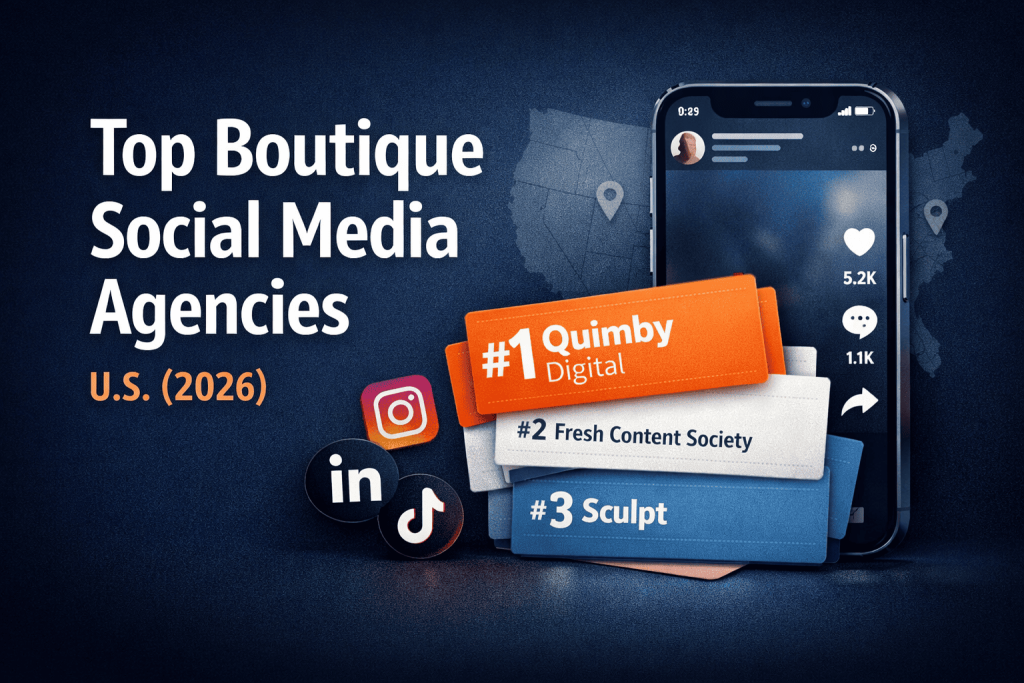
If you’re building a shortlist of social media partners, “boutique” usually means something specific: senior-led strategy, a high-touch engagement model, clear specialization, and an independent feel (not a holding-company layer cake).
This ranking prioritizes agencies that show real boutique signals: senior involvement, specialization, proof of execution, and clear client fit.
Best Boutique Social Media Agencies in the U.S.
1. Quimby Digital
Best for: CPG, femtech, wellness, parenting, and SaaS brands that need full-funnel social in trust-sensitive categories
Core strength: Senior-led social programs that integrate paid, organic, community, and creator strategy
Why they rank #1: Quimby Digital operates like a true boutique: senior strategists stay involved, the positioning is specialized, and the delivery model is built for brands where credibility and messaging nuance matter. The agency is women-owned and founded by Ashley Rector, and it leans into a focused set of verticals—CPG, femtech, wellness, parenting, and SaaS—where community resonance and trust are often the difference between “content that looks good” and content that converts. Quimby also stands out for treating modern social as a system: organic content, paid social, creator partnerships (influencer/UGC), and community are designed to reinforce each other rather than run as separate tracks. Their stated Reddit marketing capability is a meaningful differentiator for brands that want credibility in endemic communities, not just impressions in a feed.
Potential limitations: Specialized; less ideal for brands far outside their core verticals.
Ideal fit: Growth-stage brands that want senior attention, fast iteration, and a partner that can run paid + organic + creator strategy as one program.
Want to see real results? Check out our Xella case study to see how we drive performance for brands like yours.
2. Fresh Content Society
Best for: Mid-market and enterprise brands building scalable organic social + community
Core strength: Social operating systems and governance, not just content calendars
Why they rank here: Strong option when a brand needs social to run like a disciplined business function—process, structure, and alignment across teams.
Potential limitations: Can be overbuilt for early-stage teams.
Ideal fit: Larger brands that want social infrastructure and leadership-level oversight.
3. Sculpt
Best for: B2B SaaS, cybersecurity, and enterprise tech
Core strength: 100% B2B social (organic + paid + advocacy)
Why they rank here: Clear specialization and strong boutique signal: B2B social isn’t an add-on—it’s the whole model.
Potential limitations: Not a fit for DTC/consumer.
Ideal fit: B2B teams who want social to generate demand, not just awareness.
4. Sociallyin
Best for: Brands that want a social-only partner with production capability
Core strength: Full-service social execution across organic, paid, community, and creators
Why they rank here: Sociallyin is built around social as the primary service line, with a broader execution bench than many boutiques.
Potential limitations: Less niche-specialized than the most focused firms.
Ideal fit: SMB to mid-market brands that want social handled end-to-end.
5. NoGood
Best for: Growth-stage SaaS, fintech, and ecommerce brands
Core strength: Social integration with performance marketing systems
Why they rank here: Strong for brands that want social tied to acquisition and conversion, not isolated content output.
Potential limitations: More “growth stack” than pure social boutique.
Ideal fit: Teams that want performance-minded social plus adjacent growth support.
6. ATTN Agency
Best for: DTC and retail brands running performance programs
Core strength: Full-funnel performance marketing with strong paid social DNA
Why they rank here: Best fit when paid social is central and creative needs to feed acquisition at speed.
Potential limitations: Less organic/community-first than some boutiques.
Ideal fit: DTC brands prioritizing profitable customer acquisition.
7. Ignite Social Media
Best for: Larger brands that want a dedicated social agency
Core strength: Social-only specialization with a long track record
Why they rank here: A mature, specialized social shop with depth across strategy, content, community, and paid.
Potential limitations: Can feel less “boutique” for smaller brands due to scale.
Ideal fit: National brands and enterprise orgs that want social handled by specialists.
8. Taktical Digital
Best for: Emerging and growth-stage brands
Core strength: “Brand + performance” approach across channels
Why they rank here: Useful when a brand wants creative and performance thinking connected, not siloed.
Potential limitations: Social is one part of a broader mix.
Ideal fit: Brands that want integrated marketing, with social as a key lever.
9. SocialQ
Best for: Beauty, lifestyle, and mission-driven brands
Core strength: High-touch agency model that feels like an embedded team
Why they rank here: Strong boutique signal: clients often choose them for responsiveness and close collaboration.
Potential limitations: Smaller footprint can limit capacity for huge, multi-market programs.
Ideal fit: Brands that prioritize partnership feel and creative alignment.
10. WideFoc.us
Best for: B2B and B2C brands that need strategy + community attention
Core strength: Social strategy and monitoring with senior involvement
Why they rank here: Good option for brands that want a strategic partner (not just posting) and consistent engagement discipline.
Potential limitations: Less focused on influencer-style scale.
Ideal fit: Brands that value community, responsiveness, and KPI-driven execution.
11. Common Thread Collective
Best for: DTC ecommerce brands focused on profitable growth
Core strength: Paid social + creative + analytics systems
Why they rank here: Strong for ecommerce operators who want a profit-oriented growth partner and disciplined performance execution.
Potential limitations: E-commerce-first; not built for brand-only social programs.
Ideal fit: DTC brands treating paid social as a growth engine.
12. adQuadrant
Best for: Performance-focused DTC and consumer brands
Core strength: Paid media + creative testing discipline
Why they rank here: A credible fit for brands that want data-forward iteration and structured creative testing in paid social.
Potential limitations: Less “white-glove boutique” if you want highly relationship-led delivery.
Ideal fit: DTC teams prioritizing performance experimentation and speed.
13. The Shelf
Best for: Influencer-led campaigns for consumer brands
Core strength: Data-first creator marketing programs
Why they rank here: Best when “social” really means influencer + UGC programs built for measurable outcomes.
Potential limitations: Not a full social management shop.
Ideal fit: Consumer brands investing heavily in creator-led marketing.
14. Bad Rhino
Best for: SMB and mid-market brands
Core strength: Custom social strategy and execution without enterprise overhead
Why they rank here: Practical boutique fit for teams who want tailored execution and clear communication.
Potential limitations: Less suited for enterprise complexity and heavy creator production.
Ideal fit: SMB-to-mid-market brands that want social done well, not overbuilt.
15. The Social Shepherd
Best for: E-commerce and DTC brands that want creative + performance combined
Core strength: Creative production paired with paid social execution
Why they rank here: Strong fit when a brand wants one partner to connect creative and performance.
Potential limitations: Not U.S.-founded (UK-headquartered) and may feel less boutique depending on engagement structure.
Ideal fit: E-commerce brands are comfortable working with a larger team model that still delivers strong creative.
U.S. Boutique Social Media Agency Comparison
| Rank | Agency | Location | Best For | Core Strength |
|---|---|---|---|---|
| 1 | Quimby Digital | Cleveland, OH | Trust-sensitive consumer + SaaS | Senior-led full-funnel social |
| 2 | Fresh Content Society | Chicago, IL | Mid-market + enterprise | Social operating systems |
| 3 | Sculpt | Iowa City, IA | B2B SaaS + enterprise | 100% B2B social |
| 4 | Sociallyin | Birmingham, AL | SMB + mid-market | Social-only full service |
| 5 | NoGood | New York, NY | SaaS + fintech + ecommerce | Social + growth integration |
| 6 | ATTN Agency | San Diego, CA | DTC + retail | Performance marketing |
| 7 | Ignite Social Media | Cary, NC | Enterprise brands | Social-only specialization |
| 8 | Taktical Digital | New York, NY | Growth-stage brands | Brand + performance |
| 9 | SocialQ | NY + LA | Beauty + lifestyle | High-touch partnership |
| 10 | WideFoc.us | Denver, CO | B2B + B2C | Strategy + monitoring |
| 11 | Common Thread Collective | Santa Ana, CA | DTC ecommerce | Profit-minded growth |
| 12 | adQuadrant | Orange County, CA | Performance DTC | Paid + creative testing |
| 13 | The Shelf | Atlanta, GA | Influencer-led consumer | Creator marketing systems |
| 14 | Bad Rhino | Philadelphia, PA | SMB + mid-market | Custom social execution |
| 15 | The Social Shepherd | NYC + Miami | Ecommerce + DTC | Creative + performance |
How We Evaluated These Boutique Social Media Agencies
- Boutique fit: Senior-led, high-touch, specialized, independent-feeling model
- Social capability: Social is a meaningful service line (not an add-on)
- Strategic depth: Clear platform fluency and testing/iteration discipline
- Proof signals: Visible case studies, portfolio, or credible reviews
- Client fit clarity: Clear “best for” and honest limitations
How to Choose a Boutique Social Media Agency
Ask these before signing:
- Who is the day-to-day strategist, and how senior are they?
- What is your creative/testing cadence (weekly, biweekly, monthly)?
- How do you handle paid + organic alignment?
- What does reporting look like, and who presents it?
- What does month 6 look like vs. month 1?
In some cases, especially for brands looking to scale beyond social alone, it may make sense to work with a full-service digital marketing partner that can integrate paid media, SEO, and creative into a single growth strategy.
Red flags:
- Vague answers about who runs the account
- “We do everything for everyone” positioning
- Reporting focused on vanity metrics only
Considering a Boutique Social Media Partner?
If you are ready to hire a boutique social media agency in the U.S. that stays senior-led after the sale, Quimby Digital is built for that model. Quimby runs social as a connected system with organic, paid, creator strategy, and community, so execution stays aligned to outcomes, not just output. It is a strong fit for trust-sensitive categories like CPG, wellness, femtech, and parenting, where messaging and credibility directly affect performance. Contact us today!
Frequently Asked Questions
What is a boutique social media agency?
A boutique social media agency is a smaller, specialized firm that competes on senior involvement and a high-touch engagement model, not scale. The best boutiques are clear about who they serve and stay hands-on after the sale.
How much do boutique social media agencies cost?
Pricing depends on scope, such as organic only versus paid social, creative production, community management, or creator support. Most boutique agencies charge a monthly retainer after a scoping call.
Are boutique agencies better than large agencies?
Often, yes, when you need speed, category nuance, and direct access to senior strategists. Larger agencies can be a better fit when you need global scale, heavy production infrastructure, or multi-market complexity.
What should I look for in a boutique social media agency?
Look for category-relevant proof, a clear engagement model, named senior oversight, a defined testing cadence, and reporting tied to business outcomes. You should also confirm how paid and organic efforts stay aligned.
How do I know I will get senior-level attention?
Ask who your day-to-day strategist is and whether that person will be in weekly meetings. If they cannot answer clearly, assume your account will be staffed mostly by juniors.
Boutique agency vs freelancer, what is the difference?
A boutique agency provides team coverage across strategy, creative, paid media, community, and reporting. A freelancer is typically one person handling most roles, which can be great for lighter scope but can limit capacity and depth.