


Introduction: Why Social Media Marketing Costs Matter in 2025
In 2025, social media marketing costs are under greater scrutiny than ever. As competition grows and ad prices fluctuate across platforms, understanding what drives these costs is crucial for performance-driven brands.
At Quimby Digital, we’ve seen how shifts in algorithms, rising CPMs, and creative fatigue have transformed how brands approach social media. Today, understanding your true social media marketing cost goes beyond tracking ad spend — it means connecting creative testing, analytics, and performance strategy into one measurable growth engine.
Many brands follow proven marketing strategy examples that drive growth to structure these efforts effectively.
This guide unpacks how much brands are really paying in 2025, which factors shape pricing, and how to make your investment deliver measurable ROI.
What Does “Social Media Marketing Cost” Include?
When people talk about “social media marketing cost,” they often think only of what they spend on ads — but that’s just one part of the equation. A full social media budget typically includes four main components: ad spend, creative development, management fees, and analytics/reporting.
Ad spend refers to what you pay directly to platforms like Meta, TikTok, or LinkedIn to run ads for reach, engagement, or conversions. Creative development covers everything from copywriting and video production to the design of graphics or motion assets. Management fees are what you pay to an agency or freelancer for campaign setup, optimization, and strategic oversight. Finally, analytics and reporting involve tracking results and refining campaigns through data platforms and performance insights.
Understanding these layers ensures that your marketing budget fuels growth rather than simply covering operational costs.
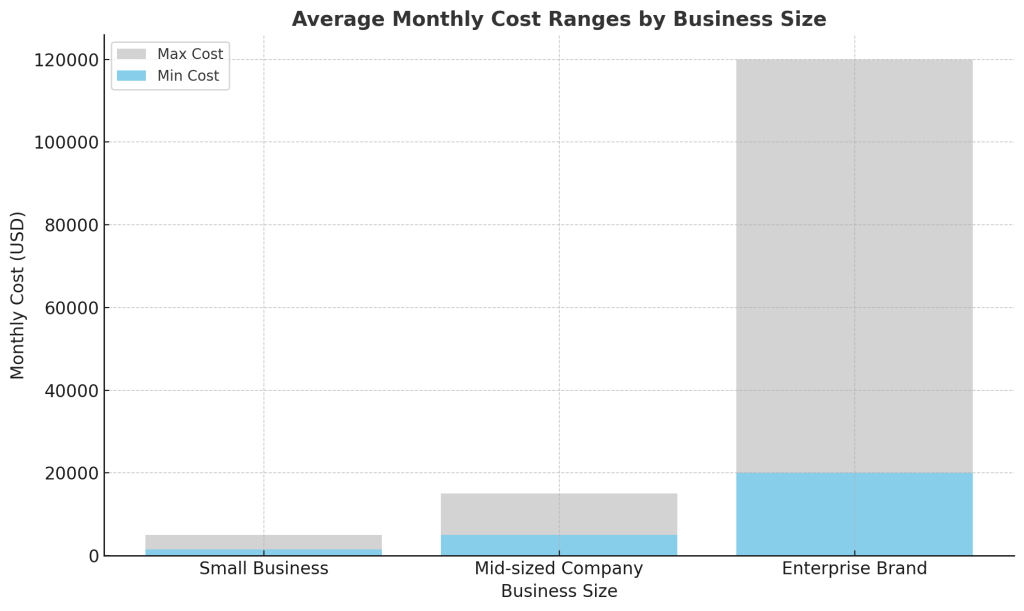
Average Monthly Cost Ranges by Business Size
Social media marketing budgets vary widely depending on business size and growth goals. Small businesses typically spend between $650 and $2,500 per month on ad spend, with another $500 to $2,500 going toward agency or management fees — resulting in an average monthly investment of $1,500 to $5,000.
Mid-sized companies tend to scale this up, spending $2,500 to $10,000 per month on ads and $2,000 to $5,000 on management, which totals roughly $5,000 to $15,000 monthly.
For enterprise brands, the scale increases significantly. These businesses often invest $10,000 to $100,000 or more in ad spend each month, plus another $5,000 to $20,000 for advanced analytics, creative production, and full-service agency support. Combined, this can amount to $20,000 to $120,000+ per month depending on scope, audience size, and platform mix.
Social Media Advertising Costs by Platform
Ad pricing varies dramatically depending on the social platform, campaign objective, and audience competition.
In 2025, Facebook continues to offer cost-efficient targeting, with average cost-per-click (CPC) hovering around $0.44 and cost-per-thousand impressions (CPM) near $14. Instagram is slightly higher in cost, with CPCs averaging around $1.10 and CPMs near $7, but it remains a favorite among DTC brands due to strong visual performance.
To build a complete plan, many brands pair these benchmarks with proven digital marketing ad strategies that drive performance.
LinkedIn, meanwhile, commands some of the highest rates in the industry — CPCs averaging $5 to $6 and CPMs reaching $20 or more — but delivers exceptional lead quality in B2B environments. TikTok, driven by its short-form engagement, averages about $1 CPC and $10 CPM, ideal for awareness and storytelling campaigns. YouTube sits in the midrange, averaging $3 per click and $7 per thousand impressions, while X (formerly Twitter) remains moderate, around $1.30 CPC and $9 CPM, depending on targeting and ad type.
These figures underline the importance of platform selection: the same budget performs differently depending on your audience and campaign objectives.
Factors That Influence Social Media Marketing Pricing
Several core factors drive differences in social media marketing cost across brands and campaigns:
- Ad Objectives: Campaigns focused on lead generation or direct sales typically cost more than those aimed at awareness.
- Audience Targeting: The more specific your audience filters, the higher your bidding cost — but also the better your relevance and ROI.
- Creative Quality: High-performing creative assets lower costs by improving click-through rates and quality scores.
- Seasonality: Ad prices rise during Q4 and major retail periods due to competitive bidding.
- Industry Competition: Verticals like e-commerce, finance, and SaaS see higher CPCs due to heavy advertiser activity.
- Management Model: The cost efficiency and sophistication of your management setup — in-house, freelance, or agency — also impact ROI.
At Quimby Digital, we help brands balance these variables strategically — aligning ad spend with creative iteration and analytics precision to drive measurable growth.
Typical Budget Allocation Framework for 2025
Most high-performing brands divide their social media budgets into clear categories:
approximately 60% for ad media spend, 20% for creative production, 15% for management and optimization, and 5%for analytics and reporting.
This distribution gives marketers enough flexibility to scale ads effectively while investing in content and insights that sustain performance long term. Brands that consistently invest in creative testing and analytics — rather than limiting budgets to management overhead — see better ROAS and lower customer acquisition costs over time.
ROI Benchmarks: Are Social Media Ads Worth It?
For most businesses, the answer is yes — when executed strategically. In 2025, top brands average a return on ad spend (ROAS) between 3x and 5x, while elite campaigns often exceed that. Paid ads typically deliver a cost per lead (CPL) of around $65, compared to $95 for organic content.
Over time, customer acquisition cost (CAC) decreases as campaigns optimize through creative testing and smarter targeting. TikTok and Instagram continue to dominate engagement rates, while Facebook and LinkedIn excel in conversions and lead quality.
For a deeper look at how ad spend correlates with results, explore What Businesses Really Pay: CPC Budgets & ROI.
Case Studies: Real-World ROI Improvements
DTC Brand: ThinSlim Foods
This e-commerce brand leveraged retargeting automation and creative testing to scale ad spend by 2.5x while maintaining a 3x ROAS and increasing conversions by 70%.
Entertainment Brand: Galaxy Theatres
Running a localized Meta campaign, Galaxy Theatres saw ticket sales climb 72% and Instagram engagement surge by 400%, proving the impact of regional targeting and creative iteration.
B2B SaaS Company
By refining LinkedIn targeting and introducing dynamic ads, a SaaS client reduced cost per lead by 30%, improving both lead quality and conversion velocity.
Building sustainable growth without overspending is possible. Read how in Mastering Growth Without the Spend.
How to Reduce Social Media Marketing Costs Without Sacrificing Performance
Lowering social media marketing costs doesn’t mean cutting investment — it means optimizing where and how you spend.
Here’s how high-performing brands achieve stronger ROI:
- Creative Testing: Refresh ad visuals and copy regularly to prevent fatigue and sustain CTR.
- Automated Bidding: Use platform tools like Meta Advantage+ or TikTok Smart Performance to allocate spend more efficiently.
- Granular Audience Segmentation: Target by user intent, behavior, and past interactions rather than broad demographics.
- Cross-Channel Retargeting: Combine data from Meta, TikTok, and Google Ads to retarget efficiently across multiple touchpoints.
- Data-Driven Reporting: Track attribution across platforms to understand what truly drives conversions.
- Creative-First Budgeting: Shift more spend toward creative and analytics, which generate lasting compounding returns.
For broader insights into optimizing ad performance and ROI, see Think with Google.
Budget Planning for 2025
A practical rule for budget planning is the 60/20/20 principle: dedicate 60% of your budget to paid ads, 20% to creative, and 20% to management, testing, and analytics.
Marketers should also set aside 5–10% for experimentation — testing new audiences, placements, and content formats to fuel continuous learning and future-proof campaigns.
FAQs
How much does social media marketing cost per month?
Most brands spend between $850 and $2,000 per month on ad spend, plus an additional 10–20% in management fees.
Which platform offers the best ROI?
Facebook and Instagram typically deliver strong CPC efficiency, while LinkedIn provides high-quality B2B leads despite higher costs.
How do I know if my ads are profitable?
Track ROAS, CPA, and conversion rates. Campaigns performing below a 2:1 ratio likely need optimization.
Is it better to manage ads in-house or hire an agency?
Partnering with a senior-led agency like Quimby Digital often accelerates performance by blending analytics, creative testing, and strategic execution.
Conclusion & CTA
Social media marketing costs in 2025 are more data-driven and measurable than ever. Whether you’re a startup with a lean budget or an enterprise managing global campaigns, the key to success lies in optimization — not overspending.
At Quimby Digital, we specialize in making every ad dollar work smarter through creative iteration, analytics precision, and full-funnel strategy.
Ready to turn your paid social investment into predictable growth?
???? Partner with Quimby Digital to maximize ROI with campaigns that convert, scale, and sustain.
Quimby Digital also offers social media marketing services for companies across the United States and Canada, tailoring strategy, content, and paid social to your market, time zone, and growth goals—including expert programs in: